
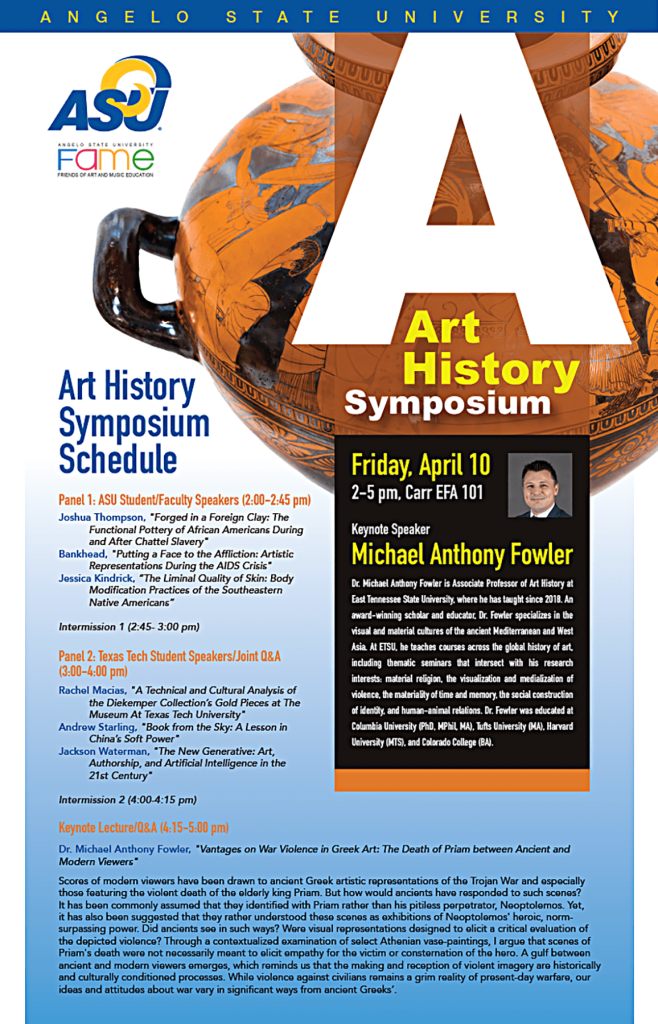
Angelo State University Art History Symposium
2602 Dena Drive
San Angelo TX, 76904
((63) 6) -578-9519
Price: Free
Date: April 10, 2026
Time: 2:00 pm - 5:00 pm
Angelo State University Art History Symposium
Friday, April 10
2 – 5 pm, Carr EFA 101
Keynote Speaker: Michael Anthony Fowler
Dr. Michael Anthony Fowler is Associate Professor of Art History at East Tennessee State University, where he has taught since 2018. An award-winning scholar and educator, Dr. Fowler specializes in the visual and material cultures of the ancient Mediterranean and West Asia. At ETSU, he teaches courses across the global history of art, including thematic seminars that intersect with his research interests: material religion, the visualization and medialization of violence, the materiality of time and memory, the social construction of identity, and human-animal relations. Dr. Fowler was educated at Columbia University (PhD, MPhil, MA), Tufts University (MA), Harvard University (MTS), and Colorado College (BA).
Angelo State University Art History Symposium Schedule
Panel 1: ASU Student/Faculty Speakers (2:00-2:45 pm)
-Joshua Thompson, “Forged in a Foreign Clay: The Functional Pottery of African Americans During and After Chattel Slavery”
-Bankhead, “Putting a Face to the Affliction: Artistic Representations During the AIDS Crisis”
-Jessica Kindrick, “The Liminal Quality of Skin: Body Modification Practices of the Southeastern Native Americans”
Intermission 1 (2:45- 3:00 pm)
Panel 2: Texas Tech Student Speakers /Joint Q&A (3:00-4:00 pm)
-Rachel Macias, “A Technical and Cultural Analysis of the Diekemper Collection’s Gold Pieces at The Museum At Texas Tech University”
-Andrew Starling, “Book from the Sky: A Lesson in China’s Soft Power”
-Jackson Waterman, “The New Generative: Art, Authorship, and Artificial Intelligence in the 21st Century”
Intermission 2 (4:00-4:15 pm)
Keynote Lecture/Q&A (4:15-5:00 pm)
Dr. Michael Anthony Fowler, “Vantages on War Violence in Greek Art: The Death of Priam between Ancient and Modern Viewers”
Scores of modern viewers have been drawn to ancient Greek artistic representations of the Trojan War and especially those featuring the violent death of the elderly king Priam. But how would ancients have responded to such scenes? It has been commonly assumed that they identified with Priam rather than his pitiless perpetrator, Neoptolemos. Yet, it has also been suggested that they rather understood these scenes as exhibitions of Neoptolemos’ heroic, norm-surpassing power. Did ancients see in such ways? Were visual representations designed to elicit a critical evaluation of the depicted violence? Through a contextualized examination of select Athenian vase-paintings, I argue that scenes of Priam’s death were not necessarily meant to elicit empathy for the victim or consternation of the hero. A gulf between ancient and modern viewers emerges, which reminds us that the making and reception of violent imagery are historically and culturally conditioned processes. While violence against civilians remains a grim reality of present-day warfare, our ideas and attitudes about war vary in significant ways from ancient Greeks’.